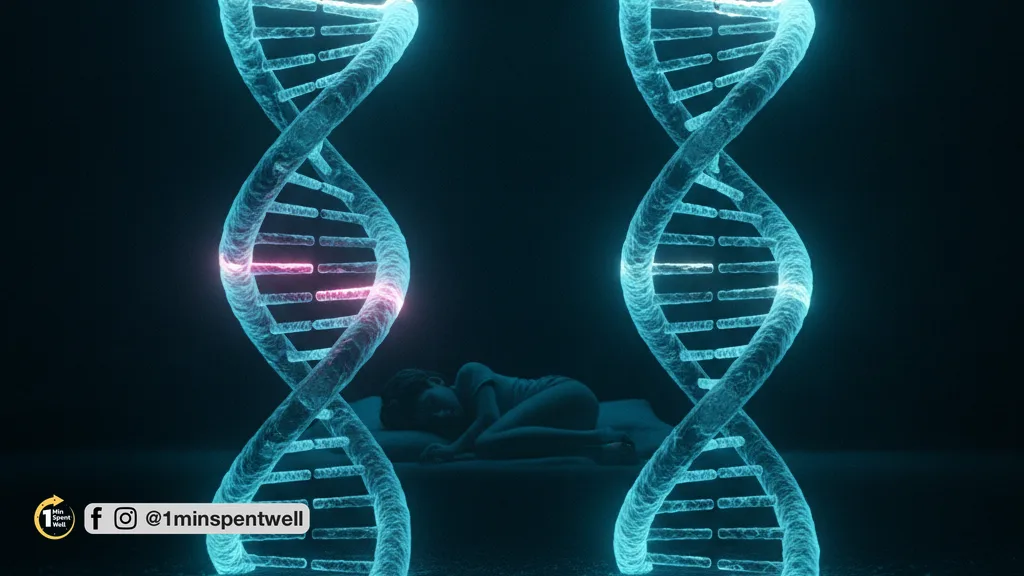
Somewhere out there, a small number of people wake up after about six hours of sleep and feel completely rested. For most of us, that would mean walking around exhausted. For them, it's just Tuesday. Scientists have spent over a decade tracing why, and the answer keeps coming back to something written into their DNA.
The first clue turned up in 2009. Researchers studying a mother and daughter noticed both slept a little over six hours a night, while their relatives without a certain mutation needed close to eight. The culprit was a single altered letter in a gene called DEC2, which normally helps regulate how much sleep the body needs. Change that one letter, and the sleep requirement itself seems to shift.
That discovery raised an obvious question: was DEC2 a one-off, or part of a bigger pattern? A decade of searching gave a partial answer. In 2019, a second short-sleep gene, ADRB1, showed up in a family spanning three generations. Carriers slept under six hours on average. Non-carriers slept close to eight, the same gap seen a decade earlier.
Then in 2020, a third gene entered the picture. GRM1 was linked to short sleep in two unrelated families, and again, carriers slept roughly two hours less than their relatives without the mutation.
Three different genes, three different families, the same result: a genetic variant that quietly resets how much sleep a person's body actually needs, without the grogginess that comes from simply cutting sleep short by choice.
It's a reminder that "I only need six hours" is sometimes a real biological trait, not just bravado. For nearly everyone else, though, that same six hours would come with a cost. These mutations appear to be rare, found in specific families, not a hidden setting most of us can unlock through willpower alone.
Sources
- He et al. "The Transcriptional Repressor DEC2 Regulates Sleep Length in Mammals." 2009.
- UC San Francisco. "Scientists Discover How Gene Mutation Reduces the Need for Sleep." 2018.
- NIH Research Matters. "Gene identified in people who need little sleep." 2019.
- UC San Francisco. "Archive: After 10-Year Search, Scientists Find Second 'Short Sleep' Gene." 2019.
- Current Biology. "Mutations in Metabotropic Glutamate Receptor 1 Contribute to Natural Short Sleep Trait." 2020.
Comments
No comments yet — be the first.