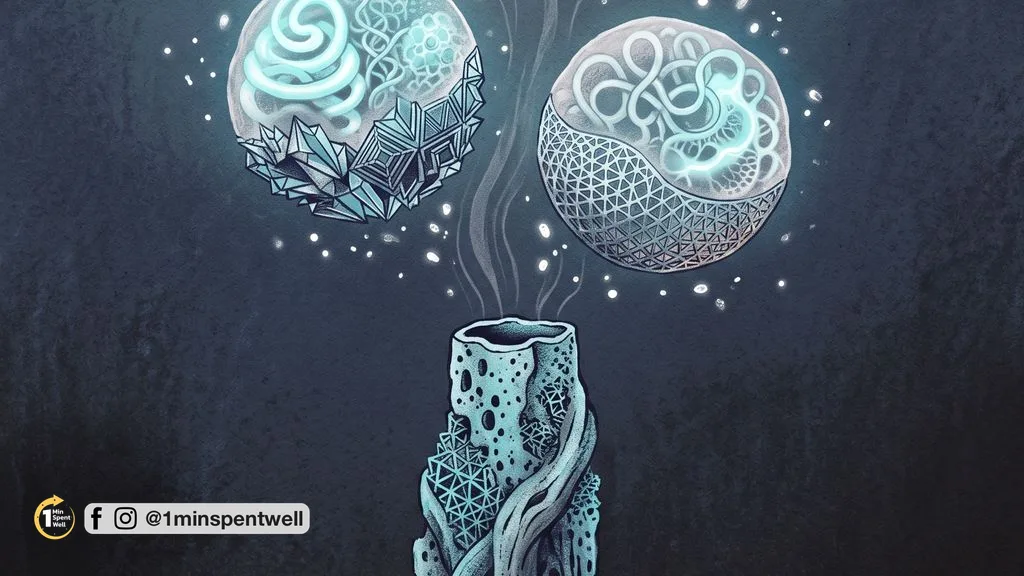
Every living thing on Earth, from bacteria to blue whales, reads its DNA using the exact same genetic code. That shared code is usually treated as proof that all life traces back to one single starting point. A 2026 study complicates that story in an interesting way: the code may have appeared once, but "life" itself might have gotten going twice.
Here's the distinction the researchers draw. Somewhere far back in time, there was a shared ancestor that already carried the genetic code we all still use. But having the code isn't the same as being a fully independent, free-living cell. According to the new research, bacteria and archaea, the two oldest branches of life, may have each crossed that finish line separately, evolving into true free-living organisms on their own, after splitting from that common ancestor. The researchers sum it up with a memorable line: one origin of the genetic code, but two origins of life.
What makes this plausible is a detail about the ancestor's chemistry. The study estimates that this ancestor relied on metal catalysts for roughly half of its core metabolic reactions, with protein enzymes handling only the other half. That's a strange, patchwork kind of metabolism, more primitive than what a modern cell runs on. It suggests the ancestor hadn't yet finished the transition into a self-sufficient living cell. It had the genetic instructions, but maybe not the fully built machinery to live independently just yet.
If that's right, bacteria and archaea didn't simply inherit a finished version of "life" from their ancestor. They may have each built the rest of it themselves, in parallel, after going their separate ways.
It's a reminder that "life" isn't one single event to pinpoint. It might be better understood as a threshold, one that could have been crossed more than once by organisms that already shared the same genetic playbook.
Sources
- Mrnjavac, Martin et al. "Intermediate stages in the origin of metabolism at a phosphorylating hydrothermal vent." 2026.
- Heinrich Heine University Düsseldorf. "Two origins of life." 2026.
- Smithsonian Magazine. "A New Study Points to Two Origins of Life on Earth by Tracing Early Chemical Reactions in Single-Celled Organisms." 2026.
- Scientific American. "Did life on Earth only arise once? Perhaps not." 2026.
- Phys.org. "Two origins of life: Free-living cells may have emerged twice as bacteria and archaea diverged." 2026.
Comments
No comments yet — be the first.