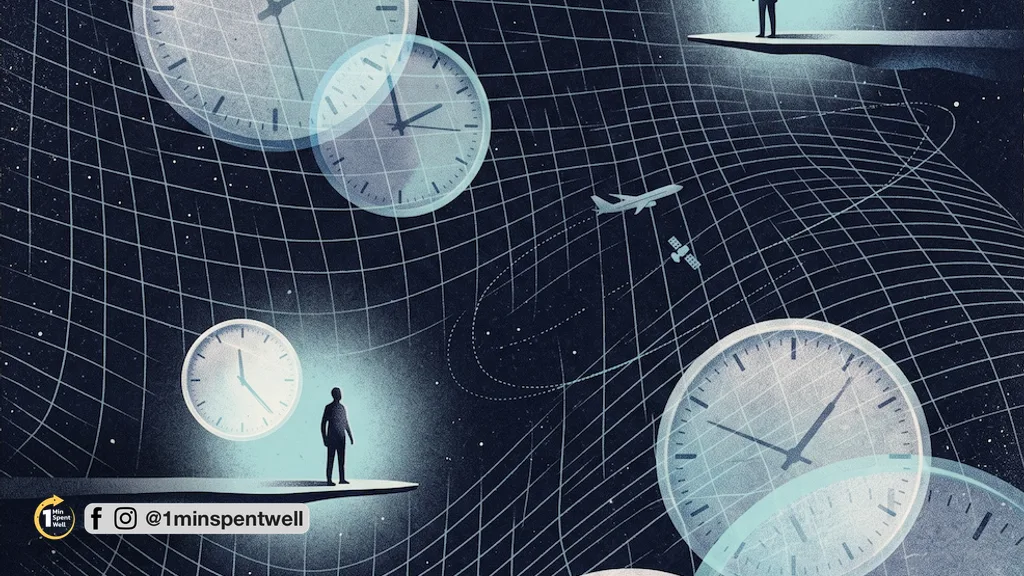
Two people can watch the same two events happen across the universe and correctly disagree about which one happened first. That's not confusion. According to relativity, it's physics.
Here's the strange part: there's no single, universal "now" ticking away for the whole universe. If two observers are moving at different speeds relative to each other, each can be right about the order of two faraway events, even if they give opposite answers. What counts as "the present moment" depends on how fast you're moving compared to someone else. The universe doesn't hand out one shared now. It hands out as many as there are observers.
And time doesn't just lack a shared present, it also doesn't pass at a shared rate. In 1971, scientists flew atomic clocks around the world on commercial jets and compared them afterward to identical clocks that had stayed on the ground. The clocks disagreed. Speed and gravity had measurably changed how fast each one ticked, not because anything broke, but because that's how time actually behaves.
This isn't a one-time curiosity from a 1970s experiment. GPS satellites run into the same effect daily. They move fast and sit far from Earth's gravity, so their onboard clocks tick at a different rate than clocks on the ground, and the system has to account for it constantly to stay accurate.
So the feeling that time flows smoothly, one present sliding evenly into the next, isn't something physics requires. Relativity describes a universe where "now" depends on your motion and clocks run at rates that depend on speed and gravity.
None of this proves time is an illusion. It shows something almost stranger: the steady, shared ticking clock we feel ourselves living inside isn't built into the universe's actual structure. What's built in is something far more flexible, and far less intuitive, than the one on your wall.
Sources
- Fourmilab (John Walker). "The Relativity of Simultaneity."
- Taylor & Wheeler, Spacetime Physics. "4.9: Relativity of Simultaneity."
- Georgia State University (HyperPhysics). "Hafele-Keating Experiment." 1971.
- Scientific American. "How Time Flies: Ultraprecise Clock Rates Vary with Tiny Differences in Speed and Elevation."
Comments
No comments yet — be the first.