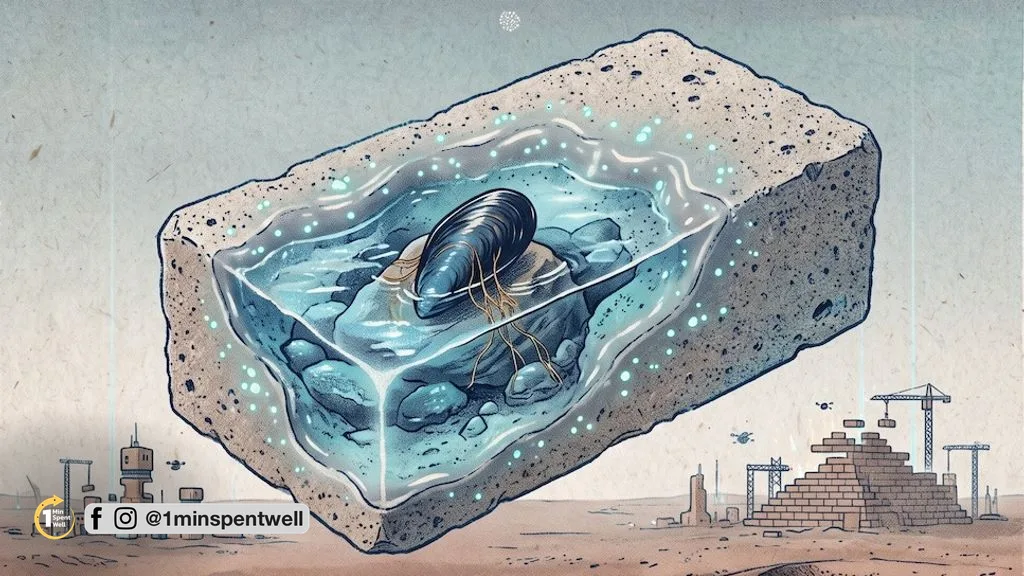
A team of researchers just 3D-printed a brick out of sand, gelatin, and genetically engineered yeast, with Mars in mind.
The yeast isn't ordinary. Researchers at Hong Kong University of Science and Technology, working with collaborators at Hong Kong Polytechnic University, engineered a strain of baker's yeast (the same species used in bread and beer) to produce adhesive proteins modeled on the ones mussels use to cling to rocks underwater. Mixed with gelatin and sand, the yeast becomes a kind of living glue, binding loose particles into a solid, printable material.
Why does this matter for Mars? Building a shelter there means you can't just ship bricks or concrete across millions of miles. Any real construction material has to be made from what's already on the surface: Martian regolith, the loose dust and rock that covers the planet. A living material that binds local dust using biology instead of energy-hungry industrial processes (think kilns and cement plants) could sidestep that problem entirely.
There's an important caveat. This study used ordinary sand as a stand-in for Martian regolith, not the real thing. Actual Martian regolith behaves differently and contains perchlorate salts, chemical compounds that are toxic to many living organisms. Nobody has yet tested how those perchlorates would affect the gelatin-yeast mixture, which means the leap from "works with sand" to "works on Mars" is still untested.
Still, the idea itself is the genuinely clever part. Instead of trying to engineer a stronger traditional material, the researchers borrowed a biological trick, mussel adhesion, evolved for clinging to wet rocks on Earth, and repurposed it for binding dry dust on another planet entirely. Whether perchlorates derail that plan is an open question. But it's a reminder that some of the most promising solutions to building on Mars might come not from heavier machinery, but from microorganisms doing what they already do well, just rewired for a new job.
Sources
- Chem Circularity (Cell Press). "Engineered living building material for low-energy construction on Mars." 2026.
- South China Morning Post. "Mars shelter problem can be solved with engineered yeast, gelatin and sand: paper." 2026.
- bioRxiv preprint. "Effect of perchlorate on biocementation capable bacteria and Martian bricks." 2025.
Comments
No comments yet — be the first.