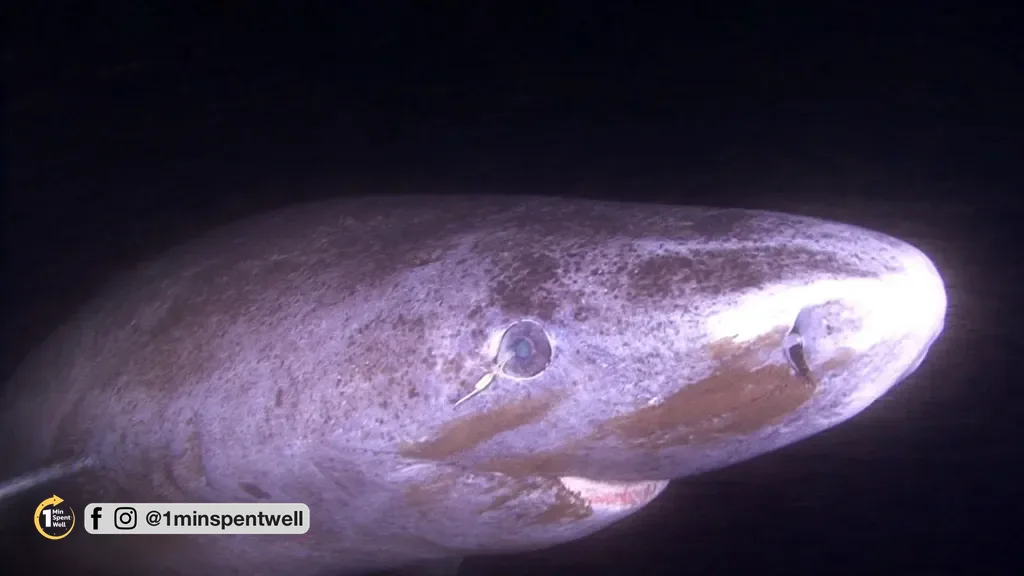
Somewhere in the cold, dark water off Greenland, a shark alive right now may have been swimming for centuries. Greenland sharks are considered the longest-lived vertebrates known to science, with lifespans that plausibly stretch across several hundred years.
That kind of life demands an almost impossibly slow pace. Greenland sharks grow about a centimeter a year, and researchers estimate they don't reach sexual maturity until roughly 150 years old. By the time one of these sharks is old enough to reproduce, it has already outlived nearly every other animal on the planet.
For decades, Greenland sharks also carried a grim nickname: the blind shark. Almost every wild individual has a parasite attached to its eye, one that damages the cornea and clouds its vision. It made sense to assume this was simply what centuries of life did to an eye, that vision failure was the price of extreme old age.
A 2026 study looked directly at that assumption. Researchers examined preserved Greenland shark eyes, including specimens estimated to be over a hundred years old, and found retinas that looked structurally healthy, with no obvious signs of age-related decline.
That's the twist worth sitting with. The blindness these sharks are famous for isn't really a story about aging at all. It's a parasite attached to the cornea, not a retina wearing down after centuries of use. Whatever allows a Greenland shark's eye to keep functioning that long, it clearly isn't following the same rules the rest of the animal kingdom does.
Sources
- Nielsen et al. "Eye lens radiocarbon reveals centuries of longevity in the Greenland shark (Somniosus microcephalus)." 2016.
- Science News. "Study ranks Greenland shark as longest-lived vertebrate." 2016.
- NOAA National Ocean Service. "How long do Greenland sharks live?" n.d.
- Encyclopaedia Britannica. "Greenland shark." n.d.
- Skowronska-Krawczyk et al. "The visual system of the longest-living vertebrate, the Greenland shark." 2026.
- UC Irvine News. "Eye-opening research." 2026.
- Borucinska et al. "Ocular lesions associated with attachment of the parasitic copepod Ommatokoita elongata (Grant) to corneas of Greenland sharks, Somniosus microcephalus (Bloch & Schneider)." Journal of Fish Diseases, 1998.
- Image credit: Ghislain Bardout
Comments
No comments yet — be the first.