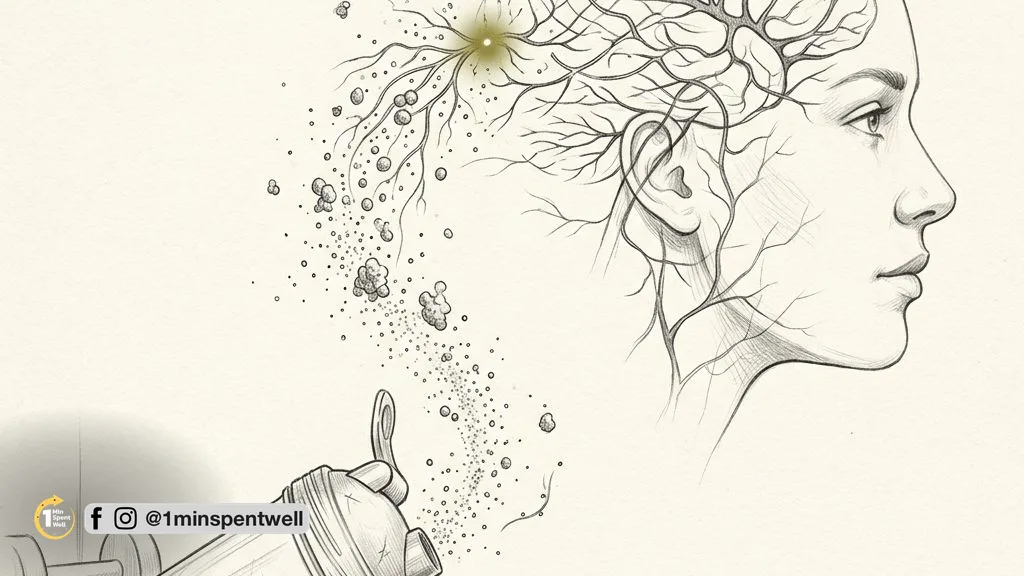
Your gym bag might contain more than a muscle supplement. Creatine, the stuff bodybuilders scoop into shakers, is now showing up in a very different kind of research: studies on depression.
Here's the surprising part. Creatine isn't just fuel for tired muscles. Small brain-scan studies suggest it can actually change energy-related brain chemistry, not just what happens in your biceps. One study looked at women with major depressive disorder who took creatine monohydrate alongside their treatment, and researchers tracked shifts in brain metabolism and network activity that went beyond what a placebo produced.
That's the signal researchers are excited about. It's also, by their own admission, far from proof. These are small studies, the kind that raise a promising question rather than answer it. A creatine supplement changing something measurable in the brain is genuinely interesting. Whether that translates into a reliable depression treatment for the general population is a much bigger claim, and the current research doesn't get you there yet.
What makes this worth watching, rather than dismissing, is that creatine already has a long track record of safety. At standard doses of roughly 3 to 5 grams a day, it's well established as safe and well tolerated in healthy adults. The most common complaint is mild stomach upset, nothing more dramatic. The popular fear that it quietly damages healthy kidneys doesn't hold up against the evidence either.
So the situation is unusual: a supplement with decades of safety data behind it, now being tested for something almost nobody bought it for. That combination is exactly why scientists are paying attention. A treatment doesn't need to be exotic to be worth studying, it needs a plausible mechanism and a good safety profile, and creatine has both.
The honest summary is this: the brain chemistry findings are real enough to justify more research, and nowhere near solid enough to call this a depression treatment. For now, it remains a supplement worth watching, not one worth self-prescribing for your mood.
Sources
- Kious, Kondo & Renshaw. "Creatine for the Treatment of Depression." 2019.
- Lyoo research group. "Effects of Creatine Monohydrate Augmentation on Brain Metabolic and Network Outcome Measures in Women With Major Depressive Disorder." 2015.
- International Society of Sports Nutrition (Antonio et al.). "Common questions and misconceptions about creatine supplementation: what does the scientific evidence really show?." 2021.
- Mayo Clinic. "Creatine." n.d.
Comments
No comments yet — be the first.