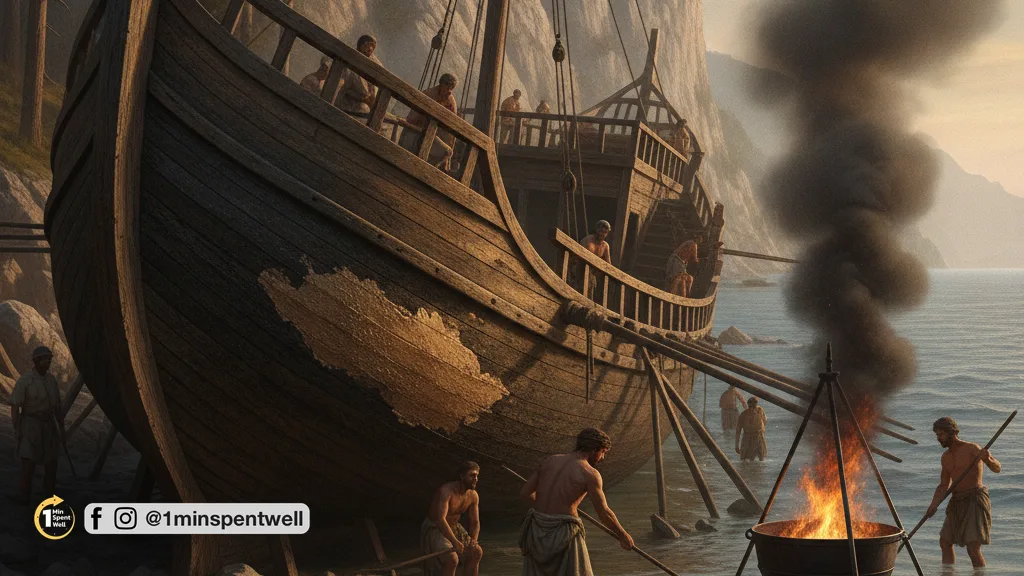
A Roman ship sank off the coast of Croatia about 2,200 years ago, and the black coating still clinging to its hull turned out to be more revealing than the cargo it carried.
Divers found the wreck near Ilovik Island in 2016, resting just 4 meters below the surface, about 500 meters from shore. Radiocarbon dating of the hull and cargo wood, checked against the style of its wine amphorae, places its construction around 170 BCE. That makes it a genuine relic of the Roman Republic, sitting almost within swimming distance of the beach for two millennia.
The ship itself was substantial: roughly 21.5 meters long and 6.5 meters wide, loaded with timber logs and jars of wine when it went down. But it's the waterproofing that has archaeologists interested. Researchers ran molecular analysis on samples of the coating and found it was mostly heated pine tar, the standard sealant for keeping Roman hulls watertight. One sample, though, was different: a mix of pine tar and beeswax rather than pure pitch.
That detail matters more than it sounds. The Roman writer Pliny the Elder described something almost identical in his Natural History, calling it "zopissa," the pitch mixed with wax that sailors scraped off ship hulls, prized because "the best is taken from ships after their maiden voyage." Whether this particular patch came from reused material or a different repair batch, the coating itself preserves a record of upkeep that the wood alone never could.
A ship's hull gets patched, scraped, and resealed constantly over its working life. Most of that maintenance leaves no trace. Here, locked into a layer of hardened tar for over two thousand years, is physical evidence that this vessel was worked on, more than once, with more than one recipe.
Sources
- CEREGE. "An Ancient Ship on the Croatian Coast." n.d.
- MaSS (Cultural Heritage Agency database). "Ilovik–Paržine 1." n.d.
- Frontiers. "Roman shipwreck reveals fascinating history of repairs throughout the Adriatic 2,200 years ago." 2026.
- Charrié et al. "Adhesive coatings in naval archaeology: molecular and palynological investigations on materials from the Roman Republican wreck Ilovik–Paržine 1 (Croatia)." 2026.
- Smithsonian Magazine. "A Brittle Coating on a 2,200-Year-Old Roman Shipwreck Reveals How Ancient Sailors Kept Their Ships Afloat." 2026.
- Popular Science. "2,200-year-old Roman shipwreck unlocks mysteries of how ships were built and repaired." 2026.
Comments
No comments yet — be the first.