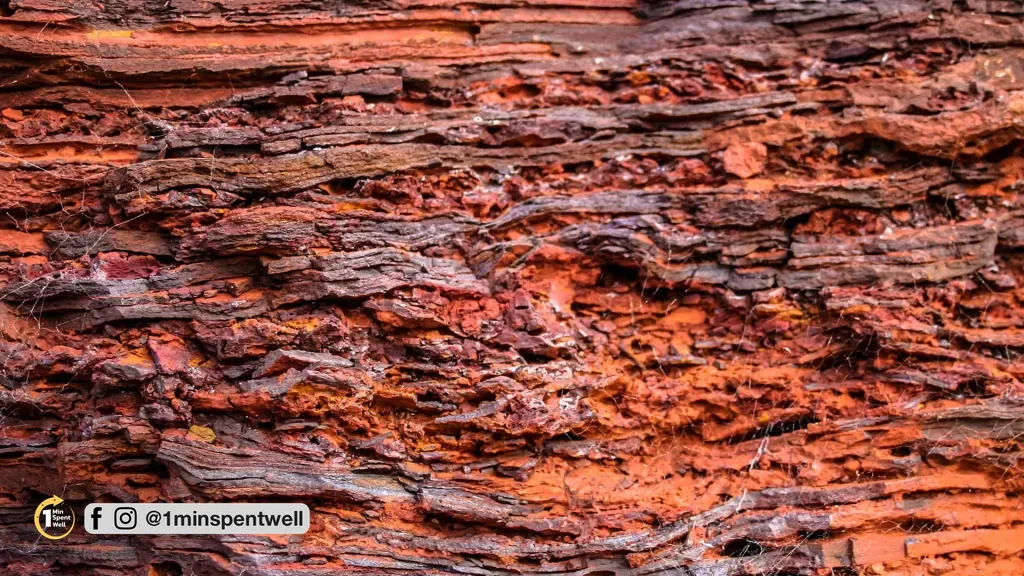
Australia's red dirt has always been famous for one thing: iron. The rusty color that stretches across the Pilbara comes from iron oxide minerals in some of the largest, oldest iron-rich rock formations on Earth. Now that same rock is drawing attention for a very different reason.
Researchers studying natural hydrogen have found that iron-bearing rock can release hydrogen gas when it reacts with water. The chemistry is straightforward once you see it: iron in its "ferrous" form (Fe2+) gets oxidized into its "ferric" form (Fe3+), and hydrogen gas comes off as a byproduct. This isn't a one-off lab curiosity. It's an established, broader phenomenon in the emerging field of natural hydrogen research, and scientists have recently pointed to magnetite, one of the key minerals in the Pilbara's banded iron formations, as more important to this reaction than previously assumed.
That matters because the Pilbara doesn't just have a little of this rock. It hosts some of the thickest, most extensive banded iron formations on the planet, layered deposits of magnetite and hematite that are also exactly why the soil there looks red. If the mineral is that abundant, the reaction has a lot of raw material to work with.
Here's the honest caveat: nobody has turned this into an industry yet. Natural hydrogen is a real, active research area, but there's no large-scale operation anywhere pulling it from the ground commercially. The closest thing to proof of concept is tiny. Since around 2012, the village of Bourakébougou in Mali has run its electricity off a natural hydrogen well discovered back in 1987, the first place on Earth to generate power this way. It's a genuine success story, but a village-scale one, not a blueprint for an industry.
So the Pilbara's red dirt may be sitting on more than iron ore. Whether that potential becomes anything beyond a laboratory finding is still an open question, but it's one worth watching.
Sources
- Frontiers in Earth Science. "Reassessing the role of magnetite during natural hydrogen generation." 2023.
- Minerals (MDPI). "Can Weathering of Banded Iron Formations Generate Natural Hydrogen? Evidence from Australia, Brazil and South Africa." 2022.
- Hunt et al. "A billion-year shift in the formation of Earth's largest ore deposits." 2024.
- ABC News (Australia). "Australia's high-grade iron ore in the Pilbara formed up to 1.4 billion years ago: study." 2024.
- The Royal Society. "Natural hydrogen could be part of a green future, but needs scientific rigor to balance hype." 2025.
- CleanTechnica. "Natural Hydrogen Is Real, Commercialization Is Not." 2026.
- Scientific Reports (Nature). "Characterization of the spontaneously recharging natural hydrogen reservoirs of Bourakebougou in Mali." 2023.
Comments
No comments yet — be the first.